
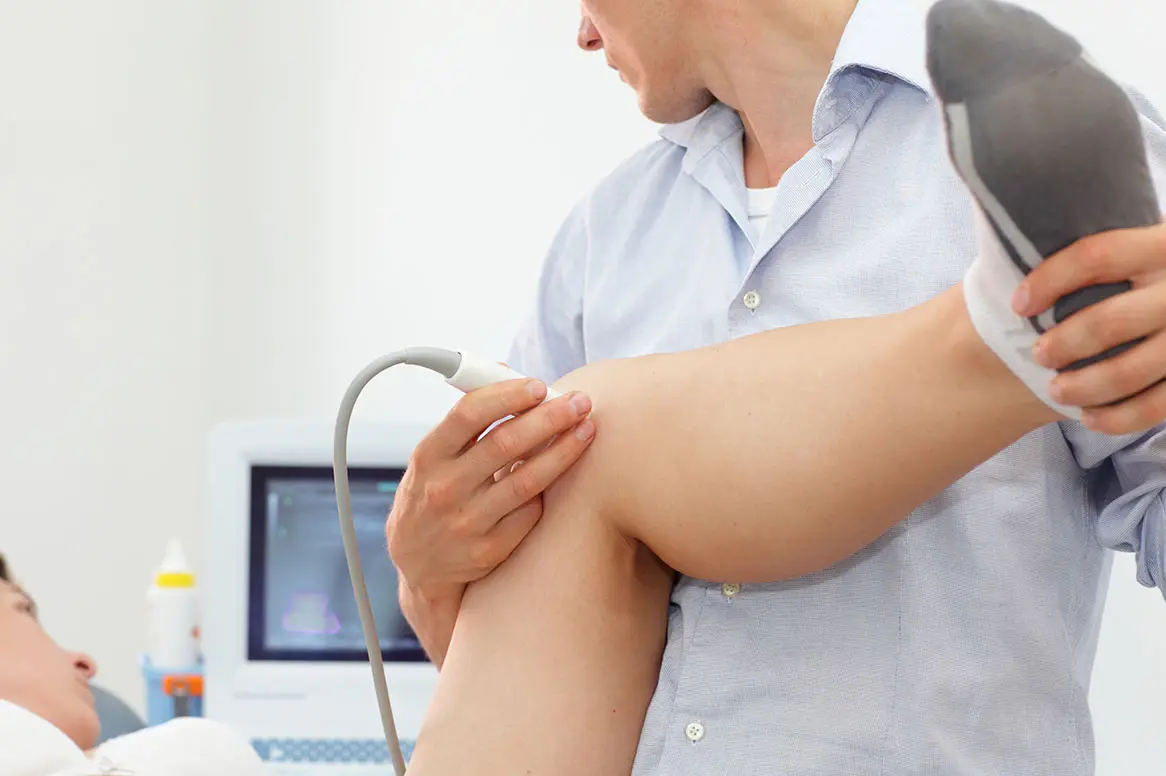
Sports injuries to muscles, tendons and ligaments are common in both children and adults. Soft tissue ultrasound is a fast, accurate and painless diagnostic method that enables examination of injured structures in real time – without radiation and without waiting.
What is soft tissue ultrasound?
Soft tissue ultrasound is a non-invasive diagnostic examination that uses high-frequency sound waves to visualise muscles, tendons, ligaments, fascia and surrounding structures. It is one of the most common examinations in sports medicine, providing the doctor with accurate insight into the condition of soft tissues.
With this examination, the doctor can assess:
- Partial or complete muscle fibre tears
- Tendon injuries (tendinopathies, partial tears, complete tears)
- Ligament injuries (sprains, partial tears)
- Swelling and haematomas
- Inflammation of bursae (bursitis, synovitis)
- Fluid collections in joints
When is soft tissue ultrasound recommended?
Ultrasound is recommended in the following cases:
- Muscle tears: After sudden pain during sports activity, which may be a sign of muscle fibre tears.
- Tendon injuries: Pain in the area of the Achilles tendon, knee, shoulder or elbow that worsens with activity.
- Ligament sprains: After ankle, knee or wrist sprains to assess the extent of injury.
- Swelling and haematomas: Unexplained swelling or bruising that does not resolve within the expected time.
- Chronic pain: Long-lasting pain in muscles or joints that limits movement.
- Injuries in children: Especially in young athletes, where quick and painless diagnosis is essential.
How is the examination performed?
The soft tissue ultrasound examination is simple and takes 15–20 minutes:
- The doctor asks about the circumstances of the injury and symptoms.
- A clear water-based gel is applied to the affected area.
- Using an ultrasound probe, the injured tissue is examined in real time.
- During the examination, you may be asked to move the limb so the doctor can assess the tissue during movement (dynamic examination).
- Immediately after the examination, the findings are explained and a report is issued.
Advantages of ultrasound over MRI
Although both examinations are valuable, ultrasound has several advantages for soft tissue sports injuries:
- Faster: The examination is completed in 15–20 minutes, without waiting for an MRI appointment.
- More affordable: Ultrasound is significantly more cost-effective than MRI.
- Real-time examination: The doctor can examine tissue during movement (dynamic ultrasound), which MRI cannot provide.
- No radiation: Ultrasound does not use ionising radiation, making it completely safe for all ages.
- Immediate report: You receive the result immediately after the examination.
Soft tissue ultrasound for children
Ultrasound is the ideal diagnostic method for children, as it is completely painless and does not require lying still in an enclosed machine, as is the case with MRI. Children tolerate it well, and the examination is quick and safe.
In young athletes, muscle and tendon injuries are common – from football players to gymnasts. With quick and accurate diagnosis, we can ensure proper treatment and prevent the injury from worsening.
For more information, visit the soft tissue ultrasound or muscle ultrasound page. To book an appointment, call us at 01 777 42 55 or book online.
Frequently Asked Questions
Focus keyword
Ultrazdravje
Medical review: Ultrazdravje – Specialistična ambulanta